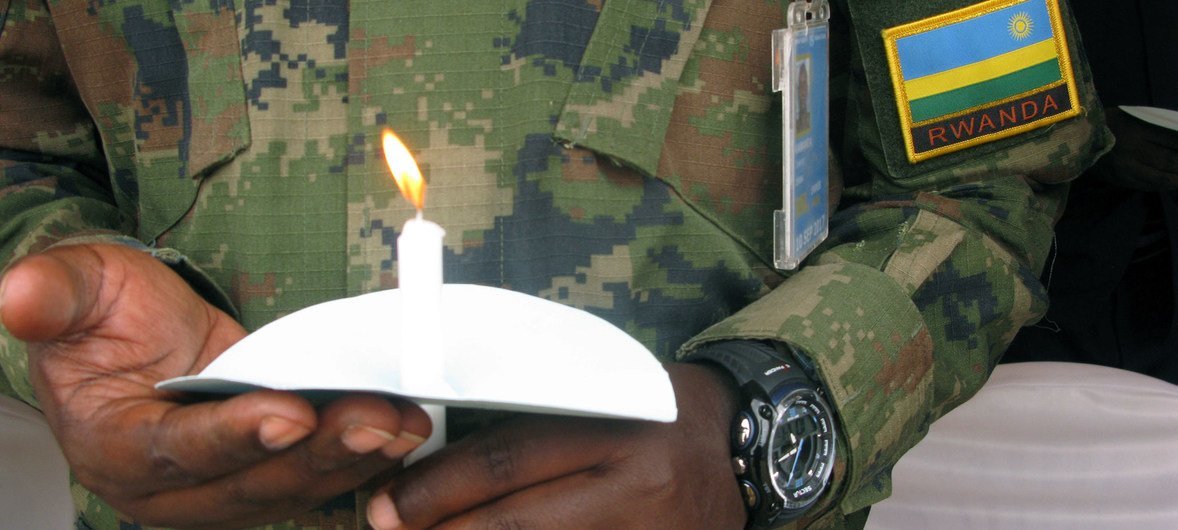
In a message to commemorate the 25-year anniversary of the Rwandan genocide, UN chief António Guterres has warned of dangerous trends of rising xenophobia, racism and intolerance in many parts of the world.
UN Photo/Beatrice Mategwa | A Rwandan peacekeeper holds a candle during to pay tribute to those who perished during the 1994 genocide in Rwanda.
April 7 marks the start of the 1994 genocide, which saw over 800,000 Tutsis, moderate Hutu and others who opposed the genocide, systematically killed in less than three months. Mr. Guterres said that the anniversary is an opportunity to honour those who were murdered, and reflect on the suffering and resilience of those who survived.
World Health Day on 7 April is a reminder that effective wastewater management and sanitation systems are vital for human health.
India’s sacred – and most polluted–river, The Ganges. Photo by Wikimedia.
5 April 2019 (UN Environment)* — The volume of sewage in the world is set to rise in line with population growth. Furthermore, the growth in global wealth means our wastewater, including sewage, contains increasing amounts of dangerous chemicals, toxic substances and the debris associated with modern consumer lifestyles.
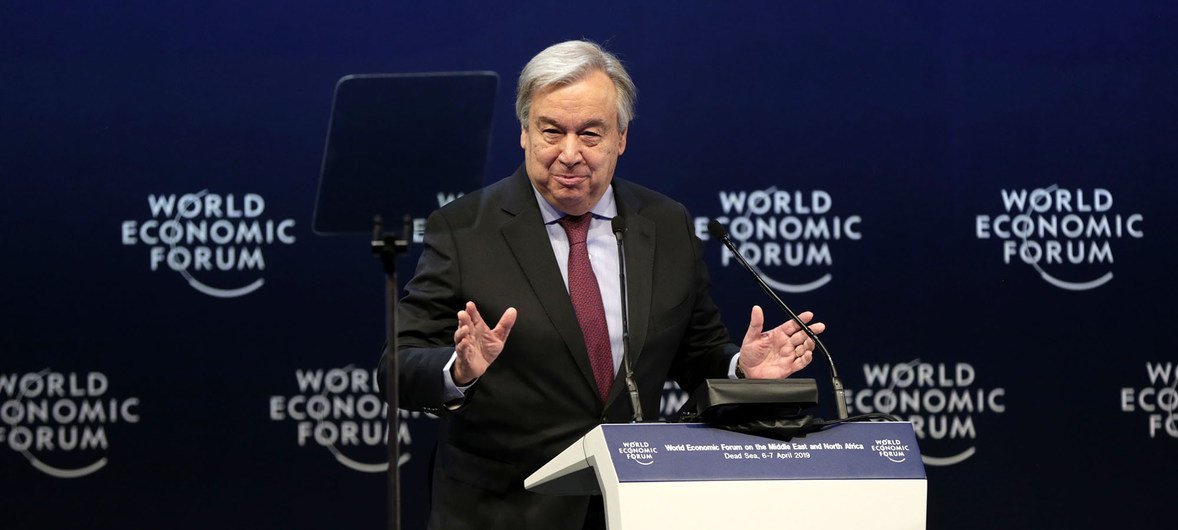
Underlining the “enormous” opportunities for sustainable development and investment in the Middle East, UN Secretary-General António Guterres has reaffirmed the Organization’s deep engagement in a “surge of diplomacy for peace,” to “untie the Gordian knot of conflict and instability.”*
Photo: UN/ Mohammad Abu Ghoush. | Secretary General António Guterres addresses the World Economic Forum at the Dead Sea, Jordan. 6 April, 2019.
The UN chief’s comments were made on Saturday [6 April 2019], during the World Economic Forum (WEF) meeting on the Middle East and North Africa, held by the Dead Sea in Jordan on April 05 and 06.
At least half of the world’s population still do not have full coverage of essential health services.
About 100 million people are still being pushed into extreme poverty (defined as living on 1.90 USD or less a day) because they have to pay for health care.
Over 800 million people (almost 12% of the world’s population) spent at least 10% of their household budgets to pay for health care.
All UN Member States have agreed to try to achieve universal health coverage (UHC) by 2030, as part of the Sustainable Development Goals.
What is universal health coverage (UHC)?
7 April 2019 (WHO)* — UHC means that all individuals and communities receive the health services they need without suffering financial hardship.
Where women can access health services, maternal deaths decrease, lengthening women’s life expectancy.
In many circumstances, men access health care less than women.
Men are much more likely to die from preventable and treatable noncommunicable diseases and road traffic accidents.
18.1-year gap in life expectancy between poorest and richest countries.
4 April 2019 (WHO)* — Women outlive men everywhere in the world – particularly in wealthy countries. The World Health Statistics 2019 – disaggregated by sex for the first time – explains why.
“Breaking down data by age, sex and income group is vital for understanding who is being left behind and why,” said Dr Tedros Adhanom Ghebreyesus, WHO Director-General.
“Behind every number in the World Health Statistics is a person, a family, a community or a nation. Our task is to use these data to make evidence-based policy decisions that move us closer to a healthier, safer, fairer world for everyone.”
GENEVA, 6 April 2019 (WHO)* — WHO was born on 7 April 1948 with a clear and ambitious vision: a world in which all people enjoy the highest attainable standard of health. Although we have made enormous progress in recent years against some of the world’s leading causes of death and disease, we still have a lot of work to do to realize that vision.
WHO/P. Albouy | Dr Tedros, WHO Director-General, among the supporters, forming the solidarity chain in Geneva on 5 April 2019 as part of the World Health Day celebrations in advocating for universal health coverage.




 HUMAN WRONGS WATCH