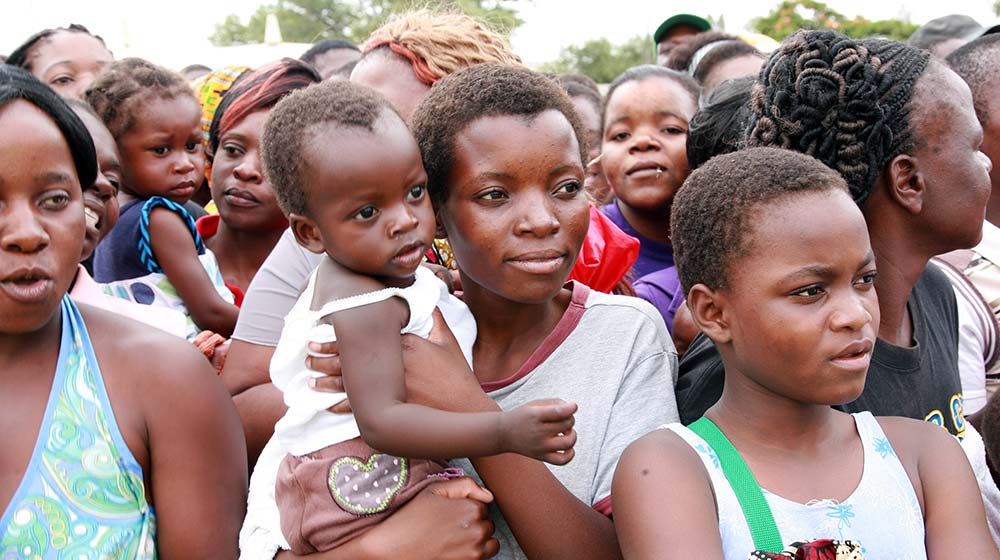
UNITED NATIONS, New York (UNFPA)* – A new data dashboard launched by UNFPA on 2 December 2020 shows that young women face the greatest risk of intimate partner violence. Yet partner violence is rampant around the world, and older women are not immune, the new tool reveals.
BULAWAYO, Dec 2 2020 (IPS)* – COVID-19 has magnified global food insecurity and is driving unhealthy eating and worsening malnutrition, food experts say. They have called for deliberate global investment in food as medicine on the back of growing diet-related illnesses.
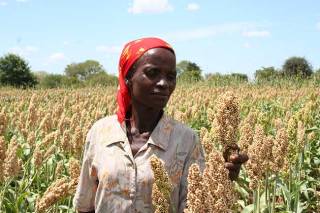
Sorghum is has nutritional and health benefits. Small scale farmer, Catherine Sibanda examines her sorghum crop in field, in Jambezi District, Zimbabwe, March 2015. Credit: Busani Bafana / IPS
Famed Greek physician, Hippocrates, foretold the future of food. He is attributed to have said: ‘Let food be thy medicine and let medicine be thy food’. COVID-19 has pushed the conversation about food as medicine onto the world agenda as more people are paying attention to their health and increasingly what they eat.
According to a recent United Nations report, more than a million species of plants and animals are currently threatened with extinction because of human activities. Rates of extinction today are as much as 1,000 times greater than the normal background rate.
As the greenhouse gas emissions of human society push the earth towards catastrophic climate change, rates of extinction in the biosphere will certainly become higher.
Are Humans Threatened with Extinction?
What about our own species? Are we too threatened with extinction?
There are certainly several threatened catastrophes that might greatly reduce the global population of humans. In a thermonuclear war, followed by nuclear winter, a large part of the world’s population might perish.
Nairobi/Seattle (UNEP)* – A special issue of the Production Gap Report – from leading research organizations and the UN – finds that the COVID-19 recovery marks a potential turning point, where countries must change course to avoid locking in levels of coal, oil, and gas production far higher than consistent with a 1.5°C limit.
UNITED NATIONS, Dec 4 2020 (IPS)* – At the height of the Cold War back in the 1960s, a Peruvian diplomat, Dr. Victor Andres Belaunde, characterized the United Nations as a politically wobbly institution that survives only at the will– and pleasure– of the five big powers.
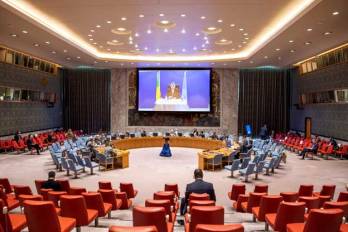
UN Security Council in session. Credit: United Nations
Simplifying his argument in more realistic terms, he said: “When two small powers have a dispute, the dispute disappears. When a great power and a small power are in conflict, the small power disappears. And when two great powers have a dispute, the United Nations disappears.”
And more appropriately, it is the UN Security Council (UNSC) that vanishes into oblivion, particularly when big powers clash, warranting a ceasefire, not in some distant military conflict, but inside the UNSC chamber itself.
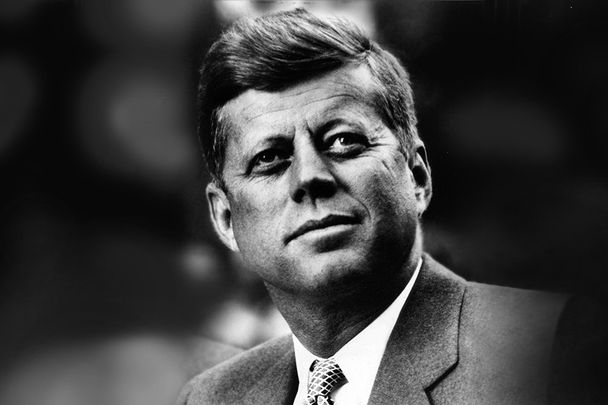
There is a vast literature on the assassination of President John F. Kennedy, who died on this date, November 22, 1963. I have contributed my small share to such writing in an effort to tell the truth, honor him, and emphasize its profound importance in understanding the history of the last fifty-seven years, but more importantly, what is happening in the U.S.A. today.
In other words, to understand it in its most gut-wrenching reality: that the American national security state will obliterate any president that dares to buck its imperial war-making machine. It is a lesson not lost on all presidents since Kennedy.
Unless one is a government disinformation agent or is unaware of the enormous documentary evidence, one knows that it was the U.S. national security state, led by the CIA, that carried out JFK’s murder.
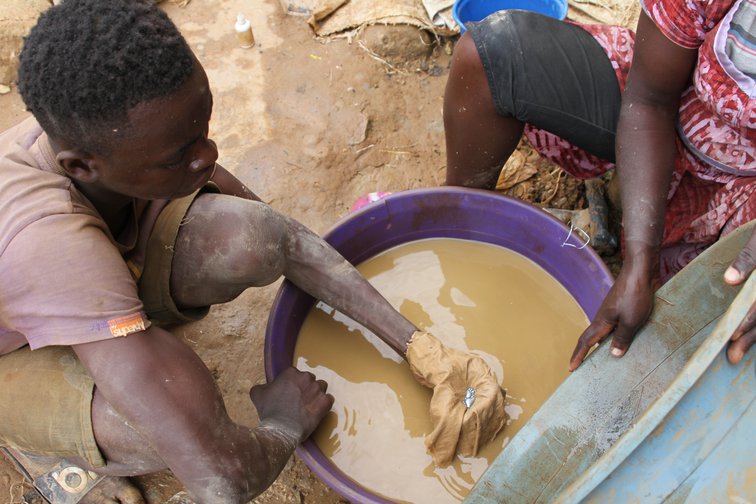
Leading companies are turning a blind eye to the violence, exploitation and environmental destruction that is endemic in the global mining industry.
Kristin Palitza/DPA/PA Image | 15-year-old Richmond Asiamah working with mercury at a gold mine in Brong-Ahafo, Ghana
4 December 2020 (openDemocracy)* — The crunching sound of bulldozers came as a death rattle for men working deep in a gold mine in eastern Zimbabwe. On 15 November, contractors’ bulldozers converged on the mine on the outskirts of Mutare. They planned to “reclaim” it from the local community, who had been mining there independently with low-tech tools and without the backing of a company (known as artisanal or small-scale mining). However, the tonnes of soil and rock poured down the mineshaft to block up its entrances created a living grave for the men still at work underground.
4 December 2020 (Wall Street International)* — All economies are fundamentally based on the exploitation of the Earth and its resources, which are not infinite.
The most important oil companies constitute less and less transparent and more powerful economies (the case of Enrico Mattei teaches), more powerful than the States in which they are active.
Soil pollution a risk to our health and food security
Photo by UNEP / 04 Dec 2020
4 December 2020 (UNEP)* — Each year, the world marks World Soil Day on 5 December to raise awareness about the growing challenges in soil management and soil biodiversity loss, and encourage governments, communities and individuals around the world to commit to improving soil health.
New FAO report examines the potential of soil organisms in ensuring sustainable agri-food systems and mitigating climate change
.
ROME, 4 December 2020 (FAO)* — Soil organisms play a crucial role in boosting food production, enhancing nutritious diets, preserving human health, remediating polluted sites and combating climate change, but their contribution remains largely underestimated, FAO on 4 December 2020 in its first ever report on “The State of Knowledge of Soil Biodiversity“.
The report was launched today on the occasion of World Soil Day, marked on 5 December.


 HUMAN WRONGS WATCH