(UN News)* — Although the global cost-of-living crisis will be an obstacle to eradicating poverty by 2030, countries can still make significant progress towards this Sustainable Development Goal (SDG), UN-appointed human rights expert Olivier de Schutter has said.
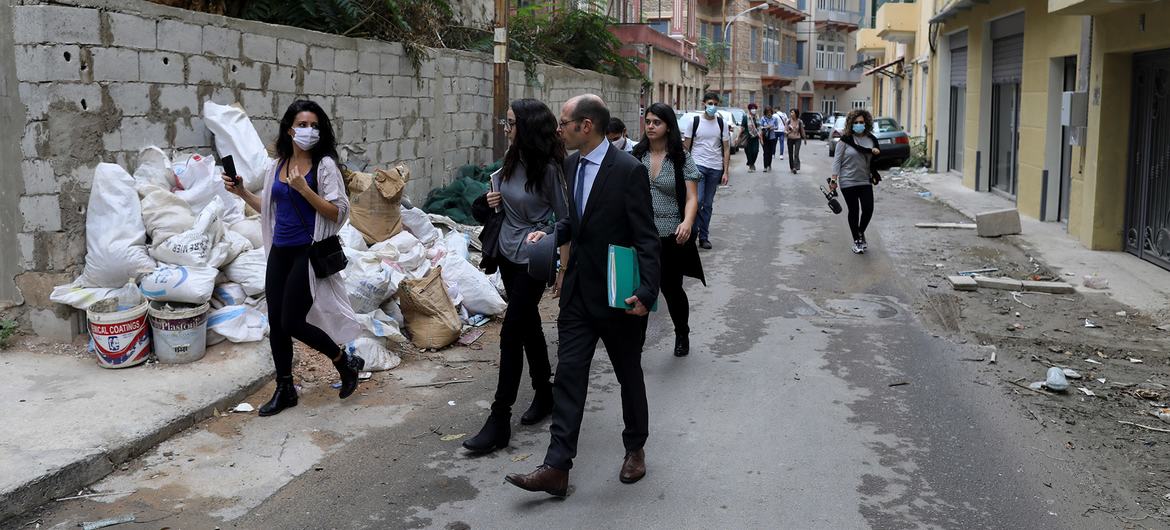
Marwan Tahtah | the UN Special Rapporteur on extreme poverty and human rights, Olivier De Schutter during his visit to Lebanon from 1-12 Novemeber 2021.
He believes the world also can move forward in stamping out negative attitudes towards the millions of people worldwide who are struggling just to get by.
“People are stereotyped and discriminated against purely because they are poor. This is frankly sickening and a stain on our society,” he told the General Assembly recently.
Rapid Assistance Critical to Families’ Survival as They Face Displacement in Somalia.
Displaced persons in Daynile, Mogadishu, receive water from a truck, thanks to an IOM activity in September. Photo: IOM/Ismail Salad Osman
Mogadishu, 28 October 2022 (IOM)* – As Somalia experiences its worst drought in four decades, more than 1.1 million people have already been forced to pack their belongings and move to other areas of the country to escape thirst and hunger. The International Organization for Migration (IOM) and partners are reaching those newly displaced with essential support to help them make it through one of the toughest experiences of their lives.
Sharm-El-Sheikh, Egypt 6 November (WMO)* – The past eight years are on track to be the eight warmest on record, fuelled by ever-rising greenhouse gas concentrations and accumulated heat.
Extreme heatwaves, drought and devastating flooding have affected millions and cost billions this year, according to the World Meteorological Organization’s provisional State of the Global Climate in 2022 report.
(UN News)* — The UN Special Adviser on the Prevention of Genocide expressed grave concern on Thursday [] over a reported resurgence of ethnic clashes in the Blue Nile region of Sudan.
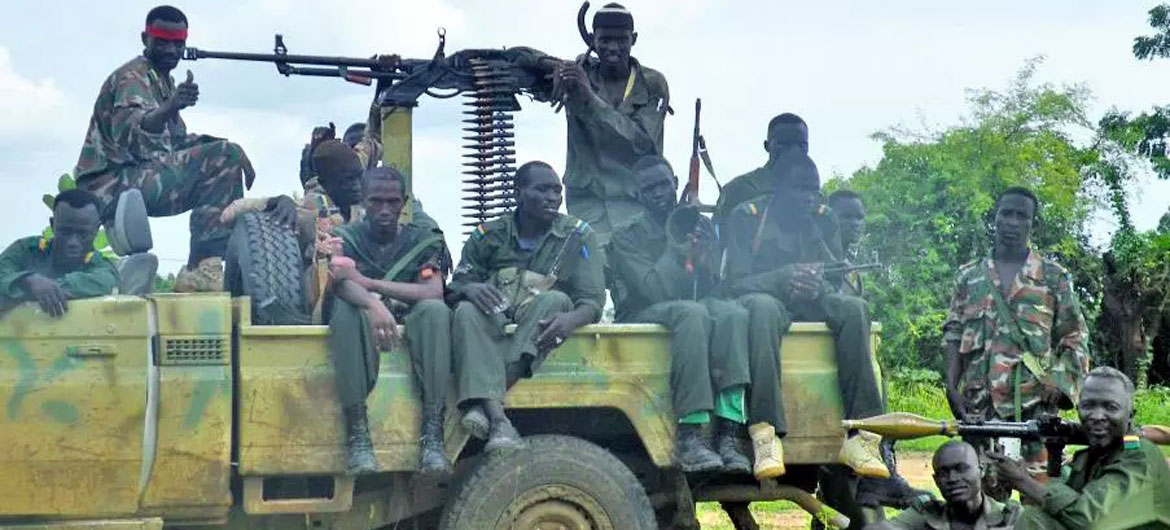
IRIN/Maryline Dumas | Soldiers are more numerous than civilians in the Blue Nile state. (file)
According to the UN, inter-communal clashes that have flared up several times since July have caused at least 359 fatalities, injured 469 people, displaced more than 97,000, and triggered extensive property damage.
“The clashes between the ethnic communities are rooted in long standing issues over land ownership and ethnic representation”, Alice Wairimu Nderitu said in a statement.
(UN News)* — Sweden should step up efforts to fight systemic racism and focus on strategies to restore trust between police and minority groups, said a UN Human Rights Council-appointed group of independent experts on advancing racial justice and equality, on Friday [].
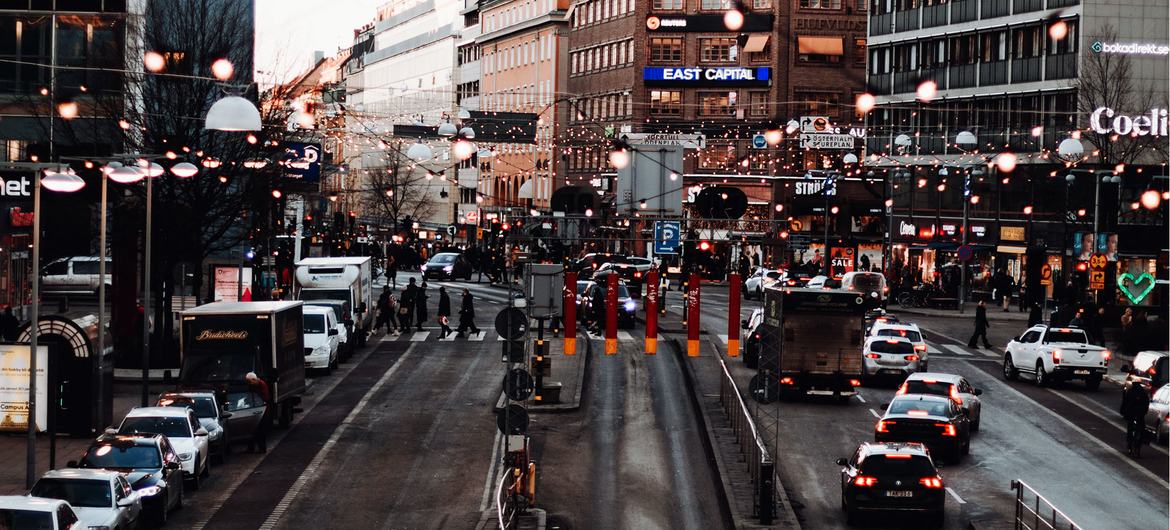
Unsplash/Tamara Menzi | Street traffic in Stockholm, Sweden.
While visiting the country from 31 October to 4 November, the members of the International Expert Mechanism gathered information on the existing legislative and regulatory measures for tackling racial discrimination.
“The collection, publication and analysis of data disaggregated by race or ethnic origin in all aspects of life, especially regarding interactions with law enforcement and the criminal justice system, is an essential element for designing and assessing responses to systemic racism”, said Chair, Yvonne Mokgoro.
MADRID, Nov 4 2022 (IPS)* – Just a few days ahead of the UN Climate Conference (COP27) in Egypt (6-18 November), new revelations show how far rich, industrialised countries –those who contribute most to the growing catastrophes- have been lying over their real contributions to climate finance.
“To force poor countries to repay a loan to cope with a climate crisis they hardly caused is profoundly unfair. Instead of supporting countries that are facing worsening droughts, cyclones and flooding, rich countries are crippling their ability to cope with the next shock and deepening their poverty.” Credit: Credit: Manipadma Jena/IPS.
The European Union is giving Ukraine €5 billion in exceptional macrofinancial assistance. Another 9 billion has been provided by the EU-sponsored fundraising campaign. However, this is not enough to cover the budget hole; Zelenski is immediately asking for another 55 billion euros. The US and EU have already donated 100 billion euros in military supplies to Kiev.
.
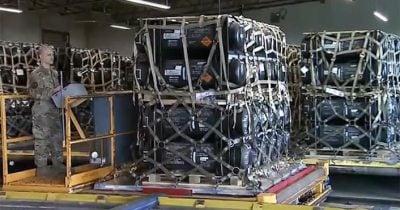
US Weapons to Ukraine – InfoBrics
Add to that billions more spent by the EU on training and arming Ukrainian forces, plus those spent for the same purpose by individual EU countries.
In the U.S., a bill is passing in the Senate that allows the Pentagon to purchase, without specific congressional authorization, huge quantities of weapons for Ukraine directly from the war industries-a colossal business for the military industrial complex, which will further increase its profits with NATO’s Ten-Year Plan to arm Ukraine by repurposing its war industry.
Fortified borders don’t stop migration – they just make inequality worse, just like climate change.
.
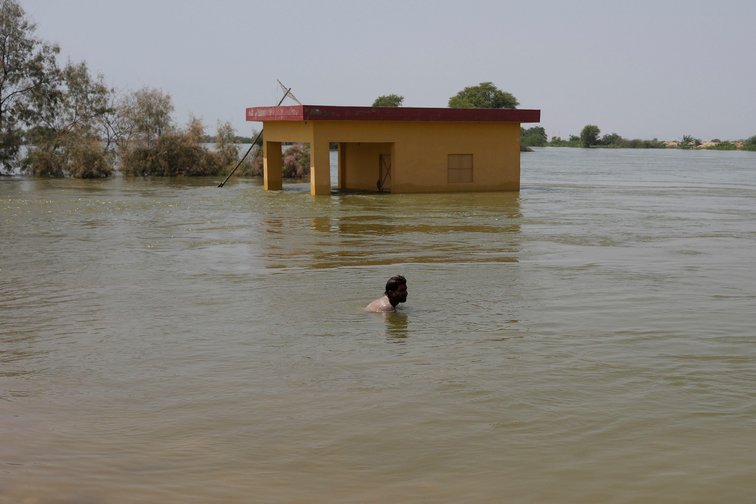
A man swims in flood water, Sehwan, Pakistan, 6 September 2022 |Akhtar Soomro/Reuters/Alamy Stock Photo
2 November 2022 (openDemocracy)* — What do monsoons have to do with border walls?
Take a recent catastrophe: in June, Pakistan’s monsoon rains triggered devastating flooding that caused one of the worst natural disasters in recent history.
Geneva, 2 November (WMO)* — Temperatures in Europe have increased at more than twice the global average over the past 30 years – the highest of any continent in the world. As the warming trend continues, exceptional heat, wildfires, floods and other climate change impacts will affect society, economies and ecosystems, according to a new report from the World Meteorological Organization (WMO).
.
Europe presents a live picture of a warming world
The State of the Climate in Europe report, produced jointly with the European Union’s Copernicus Climate Change Service, focused on 2021. It provides information on rising temperatures, land and marine heatwaves, extreme weather, changing precipitation patterns and retreating ice and snow.
CARACAS, Nov 1 2022 (IPS)* – The decision to cut oil production by the Organization of Petroleum Exporting Countries (OPEC) and its allies as of Nov. 1 comes in response to the need to face a shrinking market, although it also forms part of the current clash between Russia and the West. | En español
.
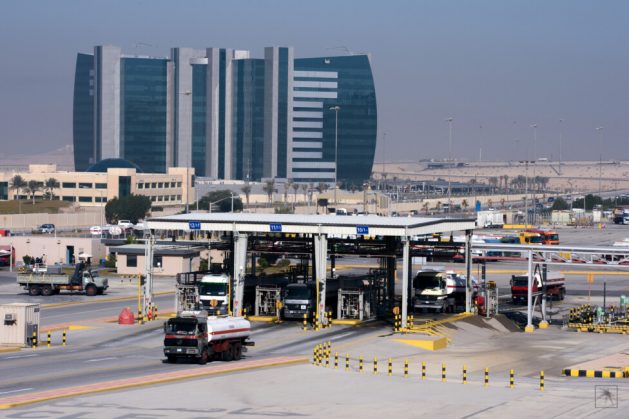
View of the bulk fuel plant in Dhahran, Saudi Arabia. Because the kingdom needs oil prices to remain high to balance its budget, it pushed OPEC and its allies to decide on a production cut as of Nov. 1. CREDIT: Aramco
The OPEC+ alliance (the 13 members of the organization and 10 allied exporters) decided to remove two million barrels per day from the market, in a world that consumes 100 million barrels per day. The decision was driven by the two largest producers, Saudi Arabia – OPEC’s de facto leader – and Russia.




 HUMAN WRONGS WATCH