Human Wrongs Watch
By Baher Kamal*

The consequences of ghost fishing are shocking | Photo re-posted from Wall Street International
Ghost fishing occurs when lost or abandoned fishing gear stays in the ocean and traps fish or other marine life, indiscriminately killing whatever it catches, explain two leading specialised international agencies—the UN Food and Agriculture Organization FAO and the UN Environment UNEP.
“Abandoned, lost or otherwise discarded fishing gear is being recognised as a topic that we must tackle now for the sake of our marine environment and the people whose lives and livelihoods depend on it.”
At least 640 000 tonnes of fishing gear is thought to be lost or abandoned in the oceans every year, the world bodies report while estimating that one tenth of all waste in the oceans is made up of this “ghost gear”.
Killing fish and other species, such as whales, dolphins, seals and turtles (some of which are endangered), is one of the many devastating impacts of ghost gear.
Unfortunately, this is not the only problem.

In fact, they explain that derelict gear can also alter seabed and marine environments; it can create problems for navigation when ships get their propellers caught in it, in the worst cases leading to capsizing and fatalities.
And ghost gear can also be washed up on the beach as litter, becoming a danger to birds and other coastal species and a health and safety hazard for beach-goers.
How Does This Happen?
There are many different ways that fishing gear can end up in the ocean, FAO informs.
Storms or bad weather can sweep it off of boats into the water. The marine environment itself can cause fishing gear to break, or fishing gear may become so entangled in other objects in the ocean that it becomes too difficult to retrieve.
“Some fishing gear may have unclear ownership and, therefore, be abandoned without repercussion. Sometimes there may be no adequate facilities in ports for boats to dispose of their end-of-life gear. Fishing gear may also be deliberately dumped as part of illegal fishing or simply be the result of accidents and human error.”
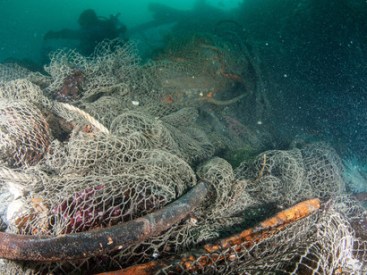
Ghost fishing harms the livelihoods of fishers and coastal communities | Photo re-posted from Wall Street International
What Does All This Have to Do with Hunger?
All of FAO’s work is done with the goal of achieving #ZeroHunger. Whether obvious or not, ghost fishing is an important issue for this in two ways:
- Ghost fishing harms our oceans and wastes the food sources within them.
With the increasing strain that all of our natural resources are facing, we cannot ignore the vital role that marine life plays for the food security of communities and peoples worldwide.
- Ghost fishing harms the livelihoods of fishers and coastal communities.
Almost 200 million people depend on fisheries and aquaculture for their livelihoods. The more illegal or ghost fishing occurs, the fewer resources fishers around the world have to earn a living and secure food sources.
As well, the amount of fishing gear remaining in the marine environment will continue to accumulate and the impacts on marine ecosystems will continue to get worse if the international community doesn’t take effective steps to deal with the problem of marine debris as a whole.
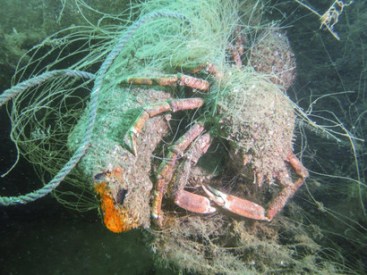
The amount of fishing gear remaining in the marine environment will continue to accumulate and the impacts on marine ecosystems will continue to get worse| Photo re-posted from Wall Street International
What to Do?
The Food and Agriculture Organisation recommends some feasible measure to prevent the oceans from being further destroyed:
Mark the Gear: Marking gear enables identification of ownership and encourages responsible management of fishing gear. It can be a good way to identify and understand where recovered gear originally came from and return it to its owner, not just to identify offenders.
Like many things, investing in the prevention of the problem through best practices, such as gear marking, may be more cost-effective than the clean-up required after gear is already lost. This is generally a better way of reducing this kind of debris and its impacts.
Improve Reporting and Recovery: Lost gear should be reported so that recovery efforts can be made. However, many vessels may not be able to retrieve the gear themselves because they lack the appropriate equipment or because it would be dangerous for the crew. Other vessels do not report losses because of fear of blame.
A “no-blame” approach could be adopted to remove the vessel’s liability for losses. Incentivised retrieval schemes could also be implemented so that vessels that are equipped to do so bring back not only their own gear but also other lost gear that they encounter at sea.
Stop Illegal Fishing: Although some gear is indeed lost by accident, some gear is abandoned as part of illegal, unreported and unregulated (IUU) fishing.
IUU fishing vessels sometimes dump their fishing gear when patrol vessels are nearby or when they have been denied entry to a port, FAO informs, adding that these ships are also less likely to report gear that may have been lost due to extreme weather conditions or human error.
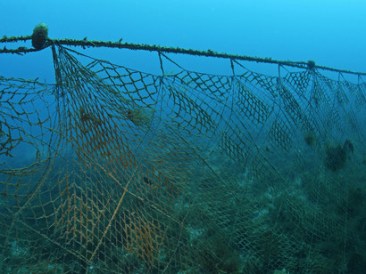
Illegal fishing | Photo re-posted from Wall Street International
The Consequences
The consequences are shocking. FAO in fact reports that such illegal, unreported and unregulated fishing human activity robs the world’s oceans of 26 million tonnes of seafood annually, bringing financial losses to a staggering 23 billion dollars a year.
Also that illegal fishing severely affects the livelihoods of fishers and other fisher-sector stakeholders and exacerbates poverty and food insecurity.
Being the United Nations an inter-governmental organisation… what are governments waiting for to act?

Baher Kamal is member of the TRANSCEND Network for Peace Development Environment and former Senior Advisor to the Director general of the international news agency IPS (Inter Press Service).
He is an Egyptian-born, Spanish-national, secular journalist, with over 45 years of professional experience. Since the 70s, he specialised in all development related issues, as well as international politics.
Baher Kamal‘s article was published in Wall Street International. Go to Original.
Recent articles by Baher Kamal in Human Wrongs Watch:
The Polar Boom: Corporations Flock to Melting Arctic for Oil and Trade Routes
Switzerland, US ‘The Most Corrupt’
Are the Miserable of the Earth Aware of Davos? Part II: Heinous Inequalities
Are the Miserable of the Earth Aware of Davos? Part I: The Nation of Millions of Jobless Youth
One Billion Mountain People Marching on Cities?
Once Upon a Time a Planet (II): Voracious Consumption, Unlimited Greed
To Be a Latin-American Migrant in Madrid
No Health Protection for Migrant-Women Healthcare Givers
Libya: Up to One Million Enslaved Migrants, Victims of ‘Europe’s Complicity’
Trump-Mideast: Much More than a ‘Kiss of Death’ to Palestinians
Resistance to Antibiotics: The Good, the Bad and the Ugly
South-South Cooperation Key to a New Multilateralism
One Third of Food Lost, Wasted – Enough to Feed All Hungry People
Desperate Need to Halt ‘World’s Largest Killer’ — Pollution
Good to Know (Perhaps) That Food Is Being ‘Nuclearised’
The Harsh Plight of 152 Million Child Labourers
Nations without Nationality – An ‘Unseen’ Stark Reality
Climate Change Summit a Step Further, Yes… But Where To?
The Roots of Exodus: Why Are People Compelled to Leave their Homes?
Pollution or How the ‘Take-Make-Dispose’ Economic Model Does Kill
What Do You Really Eat When You Order a Steak, Fish or Chicken Filet?
Not True that Hunger Doesn’t Discriminate — It Does
How to Eradicate Rural Poverty, End Urban Malnutrition – A New Approach
The World Is Running Out of Much Needed New Antibiotics
To Be an Egyptian Migrant in Rome (and by the Way Make Great Pizza)
Poor Orphan Crops… So Valuable, So Neglected
Conflicts, Climate Shocks Causing New Famines, Severe Food Crisis
Alert: Nature, on the Verge of Bankruptcy
Floods, Hurricanes, Droughts… When Climate Sets the Agenda
Europe, New Border of Africa’s ‘Great Desert’ – The Sahara
Climate-Smart Agriculture Urgently Needed in Africa
To Be a Nigerian Migrant in Italy
Forced Evictions, Rights Abuses of Maasai People in Tanzania Reported
Climate Migrants Might Reach One Billion by 2050
Yemen: African Migrants Beaten, Starved, Sexually Violated by Criminal Groups
Can the Gender Gap Be Measured in Dollars Only?
Millions of Women and Children for Sale for Sex, Slavery, Organs…
Migrants – The Increasingly Expensive Deadly Voyages
Not Just Numbers: Migrants Tell Their Stories
Climate Change-Poverty-Migration: The New, Inhuman ‘Bermuda Triangle’
Drought Pushes 1 in 3 Somalis to a Hunger Knife-Edge
Mideast: Drought to Turn People into Eternal Migrants, Prey to Extremism?
More Plastic than Fish or How Politicians Help Ocean Destruction
The Relentless March of Drought – That ‘Horseman of the Apocalypse
Re-Connect with Nature Now… Before It Is Too Late!
The ‘Water-Employment-Migration’ Explosive Nexus
Asia: 260 Million Indigenous Peoples Marginalised, Discriminated
Mideast: Growing Urbanisation Worsens Water Scarcity, Food Imports
A Grisly Tale of Children Falling Easy Prey to Ruthless Smugglers
Agony of Mother Earth (I) The Unstoppable Destruction of Forests
Agony of Mother Earth (II) World’s Forests Depleted for Fuel
Who Are the Best ‘Eaters’ and How to Use Eggplants as a Toothbrush
African Migrants Bought and Sold Openly in ‘Slave Markets’ in Libya
The Very Survival of Africa’s Indigenous Peoples ‘Seriously Threatened’
20 Million People Could ‘Starve to Death’ in Next Six Months
Indigenous Peoples – Best Allies or Worst Enemies?
Middle East, Engulfed by a ‘Perfect Storm’
Yemen, World’s Largest Humanitarian Crisis
ACP: One Billion People to Speak To Europe with One Voice
Did You Know that the Oceans Have It All?
The Unbearable Cost of Drought in Africa
‘Humanity and Social Justice, a Must for the Future of Work’
Work, What Future? Seven Big Questions Needing Urgent Response
Plastic No More… Also in Kenya
Climate Breaks All Records: Hottest Year, Lowest Ice, Highest Sea Level
New Evidence Confirms Risk That Mideast May Become Uninhabitable
The Indigenous ‘People of Wildlife’ Know How to Protect Nature
These Women Cannot Celebrate Their Day
Antarctic Ice Lowest Ever – Asia at High Risk – Africa Drying Up
UN Declares War on Ocean Plastic
Of Arabs and Muslims and the Big Ban
Every Year 700 Million People Fall Ill from Contaminated Food
A Dire Vacuum in a World in Crisis
Indigenous Peoples Lands Guard 80 Per Cent of World’s Biodiversity
World’s 40,000 MP’s Must Enjoy Their Rights – But Are They?
Want to Prevent Stroke, Diabetes, Cancer? Get Moving… Now!
Trump to Pull Out of the UN, Expel It from the US?
Inequality (III): Less Employment… and More ‘Junk’ Jobs
Inequality (II): “It Will Take 170 Years for Women to Be Paid as Men Are”
Inequality (I): Half of World’s Wealth, in the Pockets of Just Eight Men
Discover more from HUMAN WRONGS WATCH
Subscribe to get the latest posts sent to your email.
 Baher Kamal
 HUMAN WRONGS WATCH
Leave a comment